0,000 spent on advertising, up to $3,500 worth of conversion data is completely invisible to your bidding engines, driving up customer acquisition costs (CPA) and forcing smart bidding algorithms to optimize for low-value traffic.
To bridge this critical gap, solutions architects must transition from legacy client-side pixel tracking to **First-Party Data Attribution Recovery**. By introducing a secure, server-side data hub that resolves identities on your own domain and routes hashed customer identifiers directly to ad platform APIs, you reclaim lost conversion signals, preserve multi-month tracking windows, and restore the intelligence of your marketing campaigns.
---
## The Behavioral Psychology and Theory Behind First-Party Attribution
To design an effective attribution recovery pipeline, we must first understand the backend mechanics of modern identity resolution. In a standard client-side setup, the ad platform attempts to resolve user identity by reading cookie values stored in the user's local browser window. This is highly fragile.
First-Party Data Attribution Recovery shifts the identity resolution layer from the client's browser to your own secure cloud container. When a user visits your website, your first-party proxy container writes a cookie using server-side HTTP headers (`Set-Cookie`). Because this cookie originates from your root domain (e.g., `metrics.yourdomain.com`), it bypasses client-side JavaScript restrictions entirely.
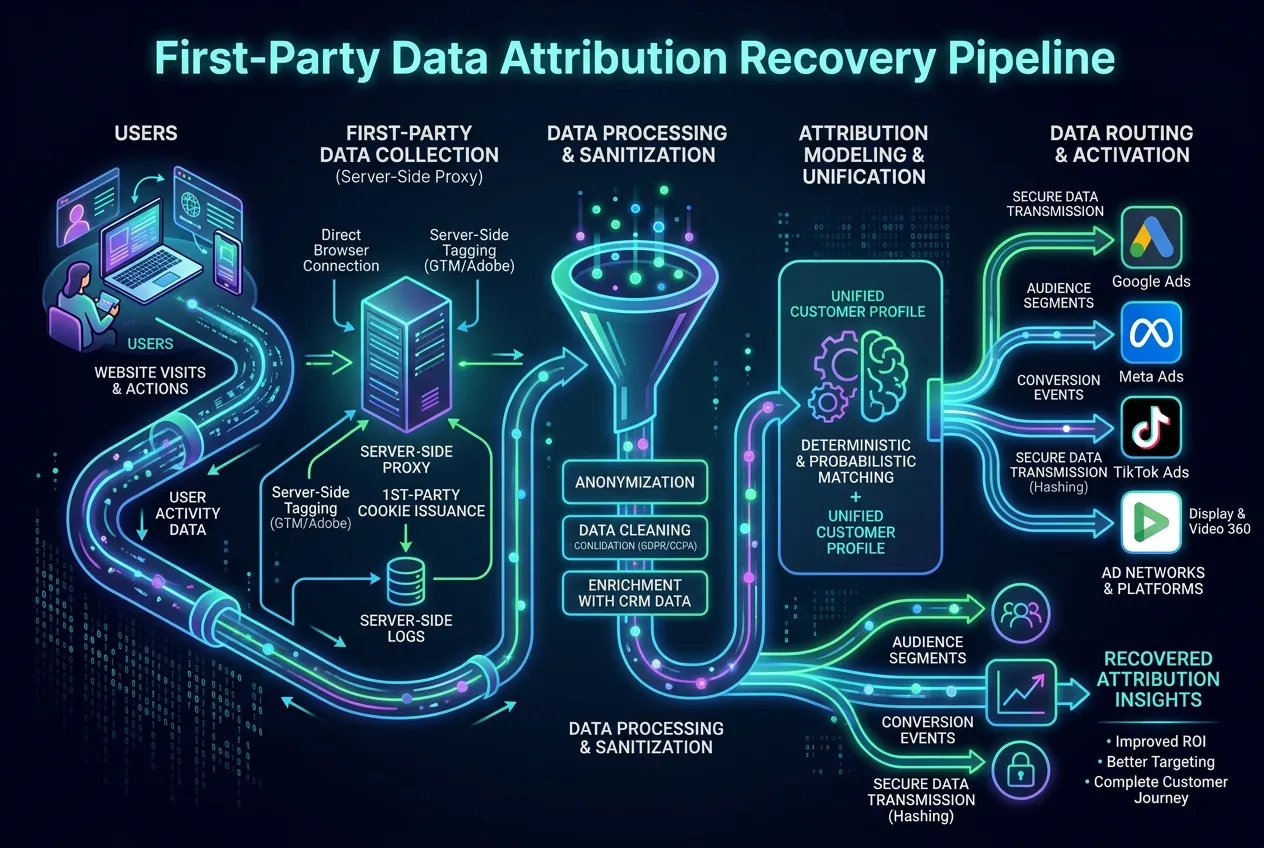
When the user takes a valuable action, your server compiles their first-party identifiers (such as an email address, phone number, and mailing address), hashes them securely using SHA-256 to comply with global privacy frameworks (GDPR, CCPA), and transmits the payload directly to the ad network's server-to-server endpoint. The platform's machine learning engine then compares this hashed data against its own active user database, matching the conversion back to the original ad click even if the browser cookie was blocked or deleted.
---
## The Failure Points of Traditional Client-Side Tagging
Relying solely on client-side JavaScript pixels introduces severe vulnerabilities to your tracking architecture:
* **Cookie Decay (Apple ITP):** Apple's Intelligent Tracking Prevention (ITP) caps the lifetime of cookies written by client-side scripts to between 24 hours and 7 days. If your B2B sales cycle or e-commerce consideration window exceeds one week, the ad network loses the connection between the conversion event and the initial ad click.
* **Ad Blockers and Privacy Extensions:** Up to 35% of internet users in high-income regions utilize ad blockers or privacy-focused browsers like Brave. These tools inspect outbound browser requests and actively block standard scripts matching known tracking libraries.
* **Browser Main-Thread Congestion:** Loading five or six heavy, third-party pixel scripts (Google, Meta, TikTok, LinkedIn, Hotjar) directly in the browser blocks execution threads, delaying page load speed and degrading Core Web Vitals (LCP and INP).
---
## Resolving the Attribution Gap with Server-Side GTM and Conversions API
Implementing First-Party Data Attribution Recovery solves these structural failures by moving data collection to a dedicated cloud proxy container (such as Server-Side Google Tag Manager or a custom Node.js server).
Instead of multiple platforms loading script packages in the user's browser, you stream a single, standardized JSON payload from your page to your server subdomain. Your cloud container then standardizes, sanitizes, and distributes the data.
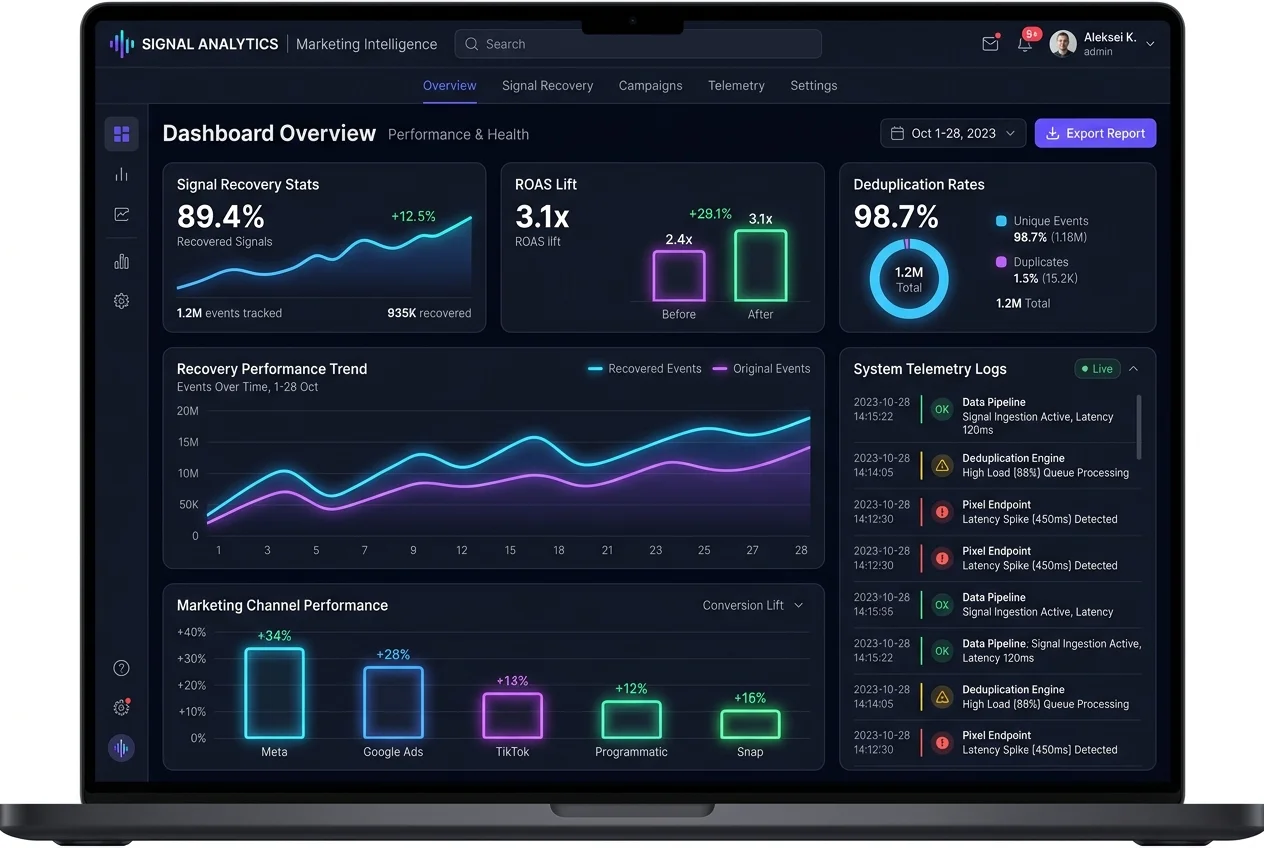
By executing data routing at the server level, you secure key operational advantages:
1. **Extended Cookie Lifetimes:** Cookies set via server-side HTTP headers are preserved for up to one year, maintaining attribution for long-cycle B2B deals and subscription renewals.
2. **Zero Ad-Blocker Interference:** Because requests route to your own first-party subdomain, they bypass standard DNS and ad-blocker lists.
3. **Enhanced Data Security:** Sensitive API keys and customer records remain secure on your server rather than being exposed in browser source code.
---
## Actionable Steps: Transitioning to a First-Party Recovery Architecture
If you are ready to implement First-Party Data Attribution Recovery in your marketing stack, follow this step-by-step migration blueprint:
### Step 1: Provision your First-Party Subdomain DNS Records
Navigate to your domain registrar (such as Cloudflare or AWS Route 53) and point a dedicated subdomain (e.g., `metrics.yourdomain.com`) to your server-side container gateway (like Google Cloud Run or AWS ECS). Use A, AAAA, and CNAME records to complete the proxy mapping.
### Step 2: Configure Asynchronous Event Buffering
In your server middleware, implement a job queue (such as Redis and BullMQ or AWS SQS) to buffer incoming conversion events. This protects against API rate limits and handles transient endpoint failures using automated exponential retry loops.
### Step 3: Implement SHA-256 Hashing Compliance
Write a utility function to format user data (email to lowercase, phone numbers to E.164 international format) and compute the SHA-256 hash before transmitting the data payload to external endpoints, ensuring complete data privacy compliance.
---
## About the Author
I'm **Waleed Raza** — a Solutions Architect and Digital Growth Engineer specializing in server-side tracking architectures, API integrations, and B2B conversion loop automation. I run [StratDigi Pros](https://stratdigipros.com), and I build high-performance data systems that recover lost marketing attribution signals for B2B and e-commerce brands globally.
If you are looking to audit your conversion tracking setup, deploy a custom Conversions API integration, or eliminate attribution leaks — let's coordinate.
→ **[Hire me on Upwork](https://www.upwork.com/freelancers/waleedraxadigitalmarketing)** | **[Connect on LinkedIn](https://www.linkedin.com/in/waleed-raxa/)** | **[Submit a project request](/contact)**
Attribution Recovery: Reclaiming 30% of Lost Ad Signals in a Privacy-First Era
DATE: 2026-07-12

## The Attribution Crisis: Why Legacy Conversion Pixels Are Failing
For years, digital marketing campaigns operated on a simple feedback loop. A user clicked a paid search or social ad, landed on your website, and triggered a browser-side JavaScript tag (like the Meta Pixel or Google Tag). This tag wrote a third-party tracking cookie to the user's browser, allowing ad platforms to track conversions, target lookalike audiences, and optimize bidding strategies.
Today, that feedback loop is severely broken. A combination of aggressive browser privacy regulations (such as Apple's Intelligent Tracking Prevention and Google's third-party cookie phase-out) and browser ad-blocking extensions has created a massive attribution gap. I have audited dozens of enterprise ad accounts and consistently found a conversion signal deficit of 25% to 35%. This means for every