Preparing for the AusAlert System: How Australia’s New Emergency Warning Protocol Works
DATE: 2026-07-25
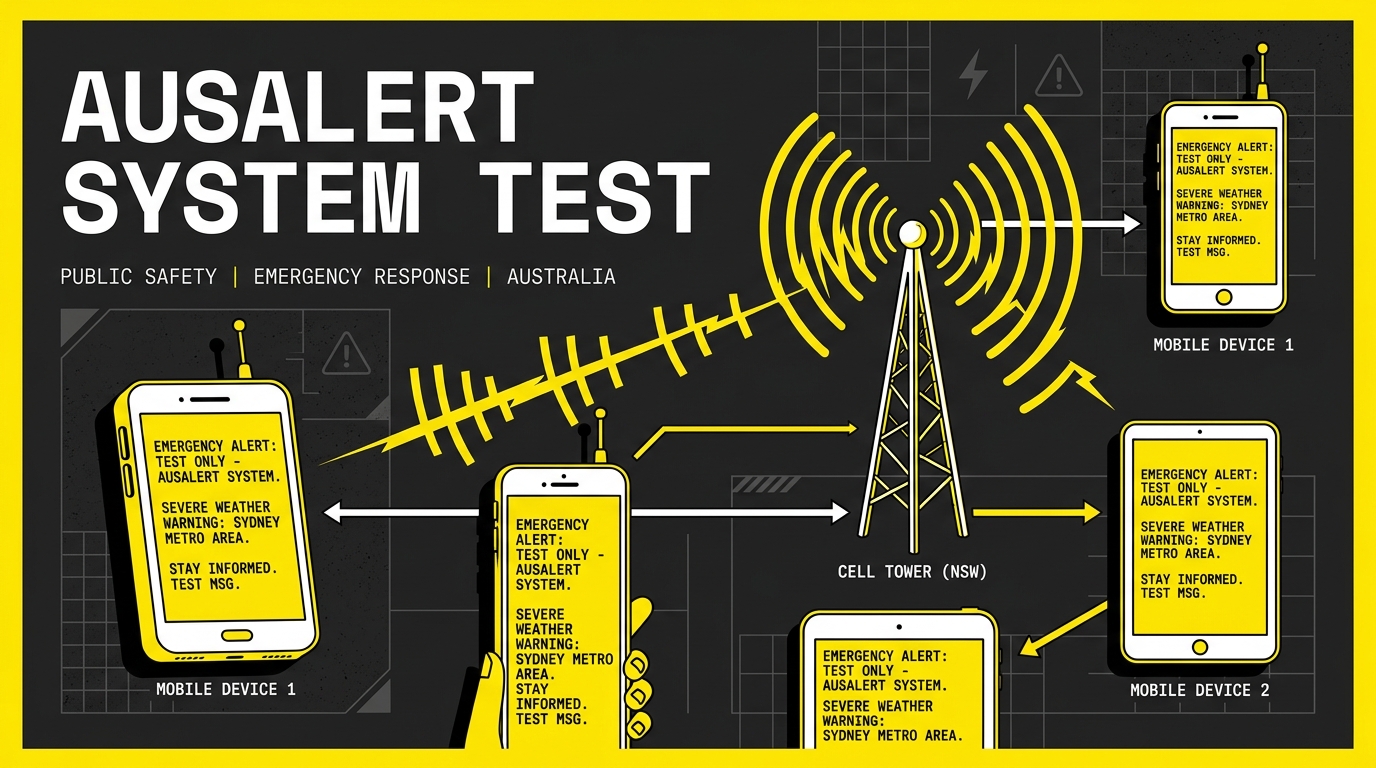
## What is the AusAlert Emergency System?
On Monday, July 27, 2026, at 2:00 PM AEST, millions of mobile devices, tablets, and smartwatches across Australia will simultaneously emit a loud, siren-like alarm. This is part of the first nationwide test of **AusAlert**, Australia's next-generation emergency warning system.
Unlike legacy SMS-based alert networks, which suffered from severe transmission delays and network congestion during critical events (such as the 2019–2020 bushfires), AusAlert is built on **Cell Broadcast (CB)** technology.
In this technical overview, we will look at how Cell Broadcast works, why it is superior to standard SMS, and what to expect during the national test.
---
## How Cell Broadcast Works: Bypassing Network Congestion
Traditional emergency alerts were sent via Point-to-Point SMS. When an emergency services agency wanted to alert a region, the system had to query the database, retrieve the phone numbers active in that area, and send an individual SMS to each handset.
This created a major bottleneck. During a natural disaster, cellular tower voice and data channels are already heavily congested by residents trying to contact loved ones. Injecting hundreds of thousands of SMS messages into a congested network caused delivery delays of hours—making the alerts useless for fast-moving hazards.
Cell Broadcast solves this by operating on a **Point-to-Multipoint** basis.
```
[Emergency Operations Center]
│
▼ (Secure CAP XML Payload)
[Cell Broadcast Center (CBC)]
│
▼ (Broadcast command over cell network control channel)
┌───────────────────────┐
│ Cell Towers │
└───────────────────────┘
│ │ │
▼ ▼ ▼ (Simultaneous Broadcast to all active handsets)
[Phone] [Phone] [Phone]
```
### The Cell Broadcast Protocol
Instead of sending a message to a specific phone number, Cell Broadcast pushes the alert message to a designated cell tower, which broadcasts it to all compatible devices within its radio range.
* **Zero Network Congestion:** It does not use standard message traffic channels. It is broadcast over a dedicated control channel that is always open, regardless of network congestion.
* **Instant Delivery:** A message can reach millions of handsets within a target area in under 10 seconds.
* **No Privacy Risk:** The government doesn't need to track or collect phone numbers in the area. Handsets simply listen to the cell tower's broadcast feed.
---
## What to Expect During the July 27 Test
When the test triggers on **Monday, July 27, at 2:00 PM AEST**, your device will react as follows:
* **Siren Sound and Vibration:** Even if your phone is set to silent or "Do Not Disturb," the alert will bypass volume controls and play a high-pitched, distinctive audio siren accompanied by rhythmic vibration patterns.
* **Visual Popup:** A text box will appear on your lock screen with the heading "Emergency Alert" or "National Test." You must tap "OK" or swipe to dismiss the alert and restore normal phone usage.
* **Compatibility:** All devices connected to active 4G or 5G networks in Australia will receive the signal. Devices on flight mode or powered off will not display the alert until they reconnect.
---
## The Technical Specs: CAP and XML Standards
Under the hood, AusAlert relies on the **Common Alerting Protocol (CAP)**, an XML-based data format standard for exchanging public warnings. This ensures that the same emergency payload can be routed to cell networks, sirens, websites, and highway digital signboards simultaneously.
Here is a simplified example of the CAP XML structure processed by the Cell Broadcast Center:
```xml
AUS-ALERT-TEST-20260725
agency@emergency.gov.au
2026-07-27T14:00:00+10:00
Actual
Alert
Public
Safety
System Test
Immediate
Minor
Observed
National Emergency Warning System Test
This is a test of the national AusAlert system. No action is required.
Australia Nationwide
```
By transitioning to this modern infrastructure, Australia aligns its emergency warning capabilities with the US (Wireless Emergency Alerts) and EU (EU-Alert) standards, ensuring reliable delivery when minutes count.
---
## About the Author
I'm **Waleed Raza** — a Solutions Architect and Systems Integrator. I design and build secure data routing systems, server automation, and tracking architectures for enterprise operations.
→ **[Hire me on Upwork](https://www.upwork.com/freelancers/waleedraxadigitalmarketing)** | **[LinkedIn](https://www.linkedin.com/in/waleed-raxa/)** | **[Submit a project request](/contact)**