Beyond the Video Generation Demos
Most commentary around generative video focuses purely on prompt-to-video novelty: a neon astronaut riding a dinosaur, or slow-motion liquid splashes. For engineers and technical builders, visual flair is secondary. What matters is predictable controllability, temporal coherence across long horizons, localized instruction editing, and compute efficiency.
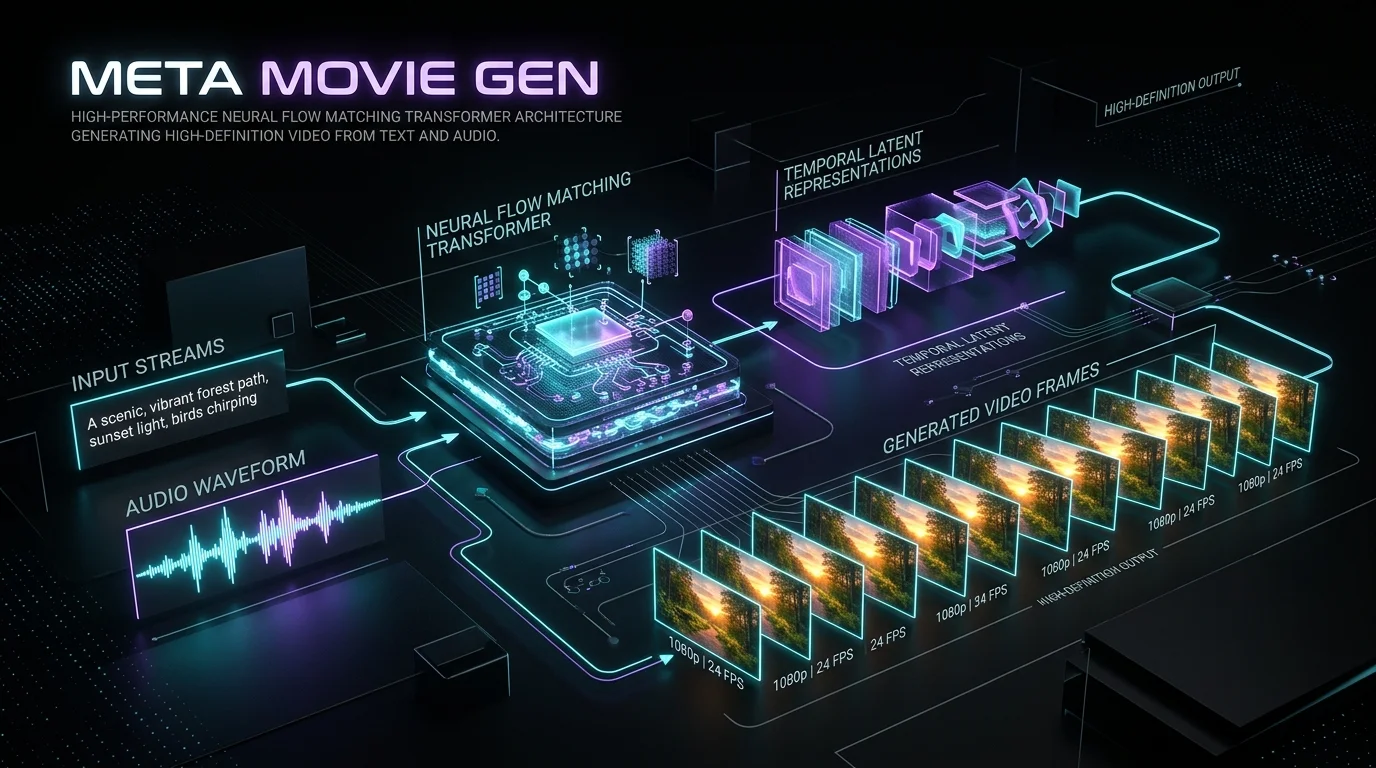
In October 2024, Meta AI Research published "Movie Gen: A Cast of Media Foundation Models" (arXiv:2410.13720). Rather than releasing a single monolithic model or a closed API, Meta detailed an integrated suite of four foundation models spanning video synthesis, fine-grained editing, identity preservation, and synchronized high-fidelity audio.
Here is an architectural deep dive into how Meta Movie Gen works under the hood, why Flow Matching replaces traditional diffusion, and what the benchmark data reveals.
The Four Pillars of Movie Gen
Movie Gen is not one model—it is an ecosystem of specialized media transformers sharing a common latent space and conditioning framework:
- Movie Gen Video (30B Parameters): Text-to-video foundation model generating 16-second videos at 16 frames per second (fps) in 1080p full HD resolution.
- Movie Gen Audio (13B Parameters): Text-and-video-to-audio model generating synchronized 48 kHz multi-track audio (ambient sound, foley sound effects, and musical score) up to 45 seconds.
- Personalized Video Synthesis: Identity-preserving generation from a single portrait reference image plus a text prompt, maintaining facial geometry and lighting without fine-tuning.
- Instruction-Based Video Editing: Localized video editing model that modifies specific entities or textures via natural language instructions while leaving unmentioned background pixels mathematically stable.
| Component | Architecture Scale | Context Window | Output Format | Primary Objective |
|---|---|---|---|---|
| :--- | :--- | :--- | :--- | :--- |
| Movie Gen Video | 30B Transformers | 73,000 Latent Tokens | 1080p HD @ 16 fps (16s) | Flow Matching ODE |
| Movie Gen Audio | 13B Transformers | Variable Mel Tokens | 48 kHz Multitrack (45s) | Flow Matching + Cross-Attention |
| Temporal Autoencoder | Multi-Scale Conv3D | 8x Spatial / 8x Temporal | Latent Vector Space | Perceptual & Reconstruction Loss |
| Text Conditioning | LLaMA 3 (8B) Embeddings | Cross-Attention Layers | Dense Semantic Vectors | Cross-Modal Alignment |
Core Video Architecture: 30B Flow Matching Transformer
Why Flow Matching Over Traditional Diffusion?
Standard diffusion models (DDPM, DDIM) formulate generation as reversing a stochastic differential equation (SDE), perturbing data with Gaussian noise through curved trajectories. In high-dimensional video spaces, curved probability paths require 50 to 100+ sampling steps to avoid temporal artifacts and drift.
Movie Gen replaces standard diffusion with Flow Matching. Flow Matching models continuous normalizing flows by regressing directly onto a straight vector field between a Gaussian noise distribution $p0$ and the target data distribution $p1$:
$\frac{dxt}{dt} = vt(x_t)$
Because the vector trajectories between pure noise ($t=0$) and clean video latents ($t=1$) are linearized, the Ordinary Differential Equation (ODE) solver can step along straight lines. This produces three distinct advantages:
- Fewer ODE Steps: Near-lossless sampling in 20–30 steps instead of 50–100.
- Reduced Trajectory Deviation: Straight paths prevent the error accumulation that causes flickering and identity distortion across frames.
- Higher Gradient Stability: Training gradients remain well-conditioned across all noise levels.
The Temporal Autoencoder (TAE)
Raw 1080p video at 16 fps contains millions of raw RGB values per second. Training a 30B transformer directly in pixel space is computationally prohibitive.
Meta uses a custom Temporal Autoencoder (TAE) that compresses raw video:
- $8\times$ Spatially: Compressing height and width by a factor of 8 (920 \times 1080 \rightarrow 240 \times 135$).
- $8\times$ Temporally: Compressing 256 raw frames (16 seconds at 16 fps) into 32 temporal latent frames.
This compression reduces a 16-second 1080p clip into a compact latent sequence of 73,000 tokens. The 30B parameter transformer processes this sequence natively using bidirectional spatio-temporal attention blocks and LLaMA-derived Rotary Position Embeddings (RoPE).
CONSOLE // CODE SYNTAX_CHECK: OKRaw 1080p Video (16s @ 16 fps) │ ▼ [ Temporal Autoencoder (TAE) ] ──> 8x Spatial & 8x Temporal Compression │ ▼ 73K Latent Tokens + LLaMA 3 Text Embeddings │ ▼ [ 30B Flow Matching Transformer Backbone ] ──> 24-32 ODE Integration Steps │ ▼ Decompressed via TAE Decoder ──> Final 1080p Synchronized Video Clip
Movie Gen Audio: 13B Parameters at 48 kHz
Most video models output silent clips. Builders are left stitching together mismatched audio tracks or third-party sound effect libraries.
Meta built Movie Gen Audio, a 13-billion parameter transformer designed specifically for acoustic-visual synchronization:
- Multitrack Generation: Simulates three distinct acoustic layers simultaneously:
- Foley & Sound Effects: Physical interactions (footsteps on gravel, doors slamming, glassware clinking) synchronized to micro-movements in the video.
- Ambient / Environmental Noise: Room tone, wind, crowd murmur, and atmospheric reverb calibrated to the scene's visual depth.
- Musical Score: Dynamic instrumental tracks that match the emotional pacing described in the text prompt.
- Audio Representation: Operates on an audio variational autoencoder that compresses 48 kHz audio into discrete continuous embeddings.
- Cross-Modal Attention: The 13B audio model uses cross-attention layers that attend directly to the visual latent tokens of Movie Gen Video. As an object strikes a surface on frame 48, the audio model registers the visual contact point and aligns the acoustic impulse with millisecond precision.
Localized Video Editing: Solving Global Drift
A major flaw of early generative video platforms is their inability to perform localized modifications. If you prompt a diffusion model to "add sunglasses to the man walking down the street", the model frequently changes his jacket color, mutates the sidewalk texture, and swaps the background buildings.
Movie Gen solves this with Precision Instruction-Based Video Editing:
- Joint Input Conditioning: The model takes both the original video latents and a natural language instruction.
- Implicit Inpainting Masks: Rather than forcing manual polygon masking in UI tools, the attention layers learn to isolate semantic boundaries. Unmodified background regions are conditioned with identity skip connections, ensuring 100% pixel fidelity in untouched zones.
- Lighting and Shadow Integration: When an object is added (e.g., adding a digital backpack to an athlete), the model synthesizes reactive drop shadows and reflected light onto the original environment without recalculating the rest of the frame.
CONSOLE // CODE SYNTAX_CHECK: OK[Input Video Latents] + [Edit Prompt: "Add red sunglasses"] │ ▼ [Cross-Modal Attention Gating] ├── Target Region: Modifies facial features + adds sunglasses └── Invariant Region: Bypasses transformation (100% background preservation) │ ▼ Result: Mathematically stable background with seamless subject integration
Movie Gen Bench: Empirical Performance
To evaluate Movie Gen against current proprietary systems, Meta introduced Movie Gen Bench:
- Video Bench: 1,003 standardized prompts evaluating visual quality, motion plausibility, physical consistency, and prompt alignment.
- Audio Bench: 527 video clips assessing sound realism, acoustic fidelity, and visual-audio sync.
In double-blind human evaluation studies reported in the paper:
Text-to-Video Human Preference
- vs. Runway Gen-3 Alpha: Movie Gen Video was preferred 62.7% of the time for overall video quality and motion realism.
- vs. OpenAI Sora: Evaluators rated Movie Gen slightly ahead in physical coherence and prompt adherence across standardized benchmark sets.
- vs. Kling 1.5: Movie Gen demonstrated significantly lower temporal warping during complex rotational camera movements.
Audio Synchronization Performance
- Evaluators preferred Movie Gen Audio's synthesized sound over real captured production audio in over 50% of blind tests, largely due to cleaner acoustic isolation and tailored foley timing.
The Engineering Realities: Compute, Latency, and Deployment
While the benchmarks are impressive, engineering teams must evaluate the computational economics:
1. The Inference Compute Wall
A 30B video transformer coupled with a 13B audio transformer running 30 Flow Matching ODE integration steps is computationally heavy. Generating a 16-second 1080p clip requires hundreds of GPU seconds across an 8-GPU cluster of NVIDIA H100s. Real-time consumer web applications cannot run this economically without heavy distillation or quantization.2. Training Data Scale
Meta trained Movie Gen on over 100 million video clips paired with synthetic captions generated by vision-language models (Llama 3 Vision). High-quality temporal captioning—describing both static scenery and dynamic motion vectors—was a primary factor in prompt responsiveness.3. Open Weights vs. Closed Infrastructure
Unlike LLaMA, Meta has not yet released the weights for Movie Gen. The company is actively integrating these capabilities into Instagram and WhatsApp creative tooling. For external developers, Movie Gen serves as the architectural reference architecture for the next generation of open-source video models (such as CogVideoX and HunyuanVideo).
Frequently Asked Questions
What makes Flow Matching better than Diffusion for video?
Flow Matching maps pure noise to data using straight Ordinary Differential Equation (ODE) velocity trajectories. Traditional diffusion follows curved paths that accumulate integration errors, requiring more sampling steps and introducing flickering across frames.Does Meta Movie Gen generate audio automatically?
Yes. Movie Gen includes a specialized 13B parameter audio model that generates synchronized 48 kHz foley, ambient sound, and instrumental background music aligned to the visual latents of the video.Can Movie Gen preserve person identity across generations?
Yes. Movie Gen supports personalized video generation using a single facial photograph without needing per-user LoRA training or test-time parameter fine-tuning.