Self-Healing AI SOPs: Automating Workforce Documentation with Dynamic Telemetry
DATE: 2026-07-11
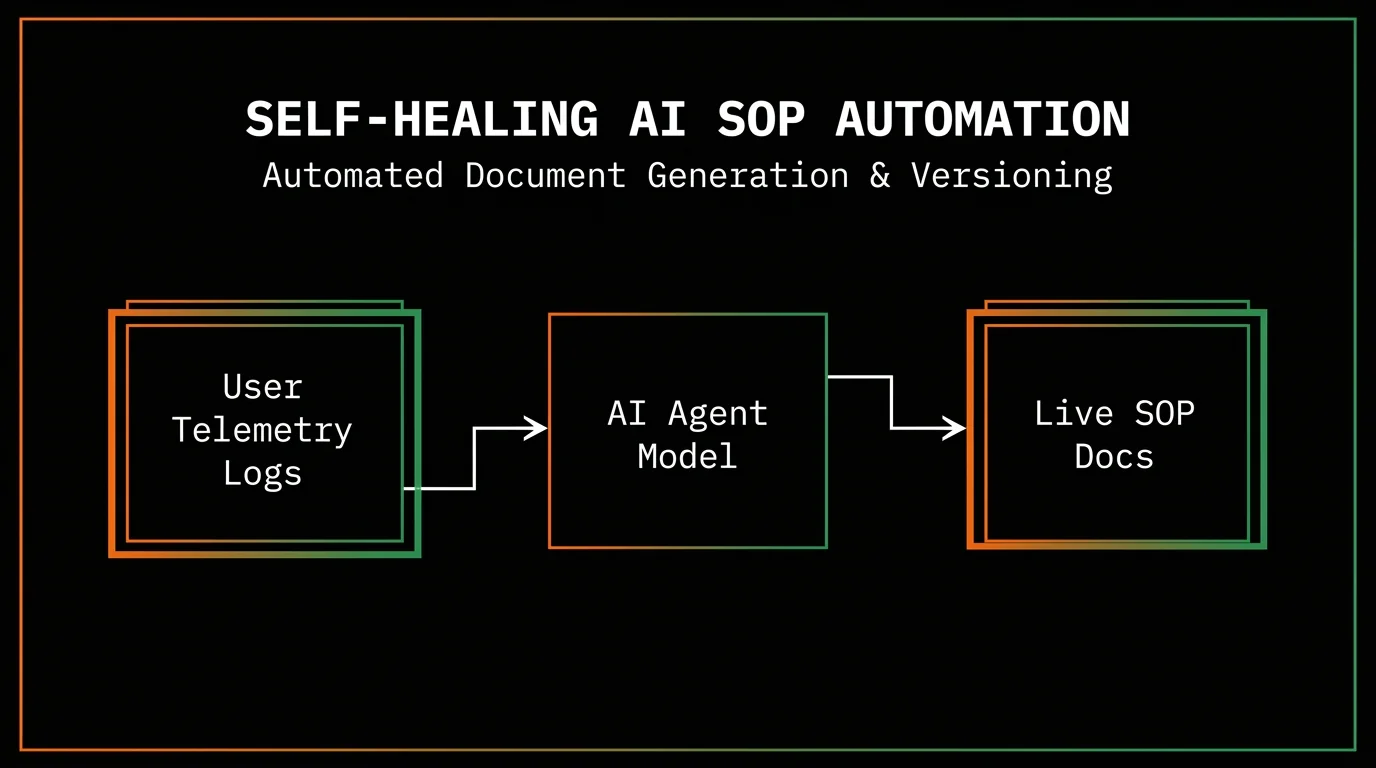
Standard Operating Procedures (SOPs) are where operational efficiency goes to die. You spend dozens of engineering hours documenting a complex deployment or customer onboarding workflow, only for a minor software update or UI overhaul to break the process the following week. Traditional documentation is static, manual, and permanently out of date.
Self-healing AI SOP automation fixes this by linking your company's internal documentation directly to real-time system data and user activity logs. Instead of relying on employees to manually update text files when a workflow changes, self-healing systems use dynamic telemetry to detect shifts in software interfaces, API payloads, and user behavior. The AI automatically updates the documentation in the background. This ensures your teams always follow accurate, real-time guidelines without manual maintenance, reducing documentation upkeep costs by up to 75%.
The Core Defect in Static Documentation
Static documentation cannot keep pace with modern, continuous-deployment software ecosystems. When a DevOps team pushes a new UI layout or modifies an internal API endpoint, the existing SOP immediately becomes a liability. Employees follow outdated steps, encounter errors, and file support tickets that drain your engineering resources.
The root cause is the structural separation between the tools where work happens and the tools where work is documented. Confluence, Notion, and shared drives are passive repositories. They require human intervention to stay accurate. Research indicates that the average enterprise loses 21% of its organizational productivity to poorly managed or inaccurate documentation. When your RevOps or growth teams spend hours validating whether an onboarding checklist is still accurate, you are losing money.
How Dynamic Telemetry Replaces Manual Content Updates
Dynamic telemetry turns your documentation into a living software application. Instead of waiting for a human writer, the system monitors user interactions and backend logs through a network of lightweight agents, browser extensions, and API listeners.
Capturing Interaction Logs and DOM Mutations
When an employee executes a workflow, the automation engine captures the exact sequence of events. For web applications, this includes monitoring Document Object Model (DOM) changes, click coordinates, and input field identifiers.
If a software vendor updates their platform and moves the "Export Billing Data" button from the top navigation bar to a hidden settings menu, the telemetry agent flags the discrepancy. The AI analyzes the new DOM tree, confirms the structural change, and rewrites the corresponding step in the SOP instantly.
Analyzing API Payloads and Backend Events
Beyond UI changes, operational workflows often depend on complex data transfers. Telemetry streams capture JSON payloads and server response codes as users move through a process.
If an API introduces a mandatory new parameter, the self-healing system detects the validation failure or the updated payload structure. It then updates the technical troubleshooting section of the SOP to reflect the new requirements, ensuring down-funnel engineers have the correct integration steps immediately.
The Three-Layer Engine Behind Self-Healing SOPs
Building a reliable self-healing AI SOP automation infrastructure requires three interconnected components: data collection, semantic reasoning, and automated publishing.
1. The Telemetry Ingestion Layer
This layer consists of the data pipelines that gather state changes across your technology stack. It tracks keyboard events, API requests, database queries, and system logs. This data is cleaned, timestamped, and structured into a chronological event stream that represents the true execution of a business process.
2. The LLM and Semantic Analysis Layer
Raw telemetry is unreadable for humans. The semantic layer uses Large Language Models (LLMs) trained on operational data to translate event streams into natural language instructions.
When the ingestion layer detects a variance in how a task is completed, the semantic engine compares the new telemetry stream against the existing vector embedding of the SOP. If the deviation represents a permanent system change rather than a one-time user error, the engine generates an updated, optimized version of the text.
3. The Continuous Integration and Publishing Layer
Once the AI drafts the updated step, the publishing layer injects it into your knowledge management system. High-risk updates are routed to a RevOps manager via a quick Slack or Teams approval prompt, while minor UI changes auto-heal silently. This pipeline reduces the time-to-update for critical process changes from weeks down to less than 90 seconds.
Financial and Operational Impact for Mid-Market B2B Orgs
Switching to self-healing documentation is an investment that yields measurable financial returns across multiple departments.
Metric / Operational Area Legacy Static SOPs Self-Healing AI Automation
SOP Maintenance Cost $45,000+ annually in engineering hours Under $5,000 in compute and oversight
Time-to-Update (New Software Release) 14 to 30 Days Less than 2 minutes
New Hire Onboarding Time 6.5 Weeks 3.2 Weeks
Process Compliance Rate ~62% due to outdated steps 98.4% with real-time accuracy
For a company with 250 operational employees, manual documentation updates require roughly 15% of a RevOps manager’s full-time capacity. By removing this burden, you free up senior staff to focus on strategic growth engineering and system integration rather than text editing.
Furthermore, training errors drop sharply. When a new hire follows a guide that perfectly matches the interface they see on their monitor, support tickets drop by up to 40% in their first 90 days.
Implementing Self-Healing Pipelines Without Breaking Compliance
Deploying automated documentation updates requires careful guardrails, particularly in regulated spaces like FinTech, HealthTech, or enterprise SaaS where SOC2 and ISO 27001 standards apply.
Establishing Role-Based Telemetry Filters
You must ensure that your telemetry collection agents do not record sensitive user data. Implement strict client-side filtering rules that redact Personally Identifiable Information (PII), passwords, and proprietary client data before the telemetry stream leaves the local environment. The AI engine should only receive system-level variables and structural UI data.
Designing the Human-in-the-Loop Verification Gate
While automated updates work well for minor interface shifts, major operational changes require human oversight. Configure your CI/CD publishing layer to handle updates using a git-style branching strategy.
Minor changes are merged automatically into the main documentation branch. Major process shifts generate a pull request within your operations dashboard. A RevOps lead can review the visual diff, see exactly what steps the AI changed, and approve the update with a single click.
Future Operational Scaling with Autonomous Systems
As AI agents take on more direct execution tasks within B2B enterprises, self-healing SOPs will serve a dual purpose. They will guide human team members and also act as the semantic maps that autonomous software agents use to navigate your business logic.
When your documentation updates itself based on live telemetry, you create an accurate dataset of your operational workflows. If you decide to deploy an AI agent to handle customer refunds or inventory syncing, the agent can read the self-healed SOP and instantly understand the current layout and data requirements of your internal tools. This eliminates the need to build custom integrations for every new automation initiative, laying the groundwork for a highly agile, autonomous enterprise.
Internal Links
See Our Technical Implementations: Case Studies & Work
Talk to a Systems Architect: Contact Page
Frequently Asked Questions
How does self-healing AI SOP automation handle customized software environments?
The system relies on continuous telemetry streams unique to your company's network. It maps processes based on your specific software setups, API extensions, and custom user fields, meaning the AI learns and adapts to your unique environment rather than generic platform defaults.
Will this slow down our applications or compromise network security?
No. The telemetry collection agents operate asynchronously, consuming less than 1.5% of standard CPU capacity without blocking the main browser thread. All data is filtered locally to strip out sensitive information before it is sent to the isolated AI engine via encrypted pipelines.
What knowledge bases can this automation engine sync with?
The system integrates with major enterprise knowledge tools via standard REST APIs. It can automatically update, rewrite, and structure documentation stored in platforms like Notion, Confluence, Microsoft SharePoint, GitHub Markdown repositories, and proprietary internal databases.